
Direct Summary (Quick Answer)
Window and door screen mesh is a specialized woven or coated fabric designed to provide insect barrier protection, optical visibility, natural ventilation, and solar shading. Screen meshes are categorized by core material (vinyl-coated glass fiber, vinyl-coated polyester, aluminum wire, or 90/10 copper-zinc commercial bronze), mesh weave count (number of warp and fill yarns per square inch, such as standard 18x16, dense 20x20, or heavy 17x10), and yarn/wire caliper (ranging from nominal 0.011 in. wire and 0.0115 in. fiberglass yarn up to 0.025 in. heavy-duty polyester). Selecting the proper mesh requires balancing optical clarity and airflow considerations against physical tear resistance, solar heat dissipation, and local environmental factors like coastal salt air.
Understanding Mesh Geometry: Weaves, Calipers, and Openness
How to Approach Screen Mesh Specifications
To ensure technical precision, information across this manual is distinguished into four specific tiers of authority:
- Consensus Industry Standards: Formal specifications established by international consensus bodies, such as ASTM International standard specifications.Consensus Industry Standard
- Manufacturer Specifications: Published physical dimensions, yarn diameters, openness percentages, and ratings for specific branded product lines.Manufacturer Specification
- Common Trade Practices: Widely observed fabrication, field installation, and rescreening techniques across the fenestration trade.Common Trade Practice
- Variable by System / Environment: Material characteristics that legitimately depend on exposure conditions, frame extrusion rigidity, or custom mill dies.Variable by System / Environment
While replacement mesh is often viewed simply by color (charcoal, black, or gray), its performance is governed by precise woven geometry:
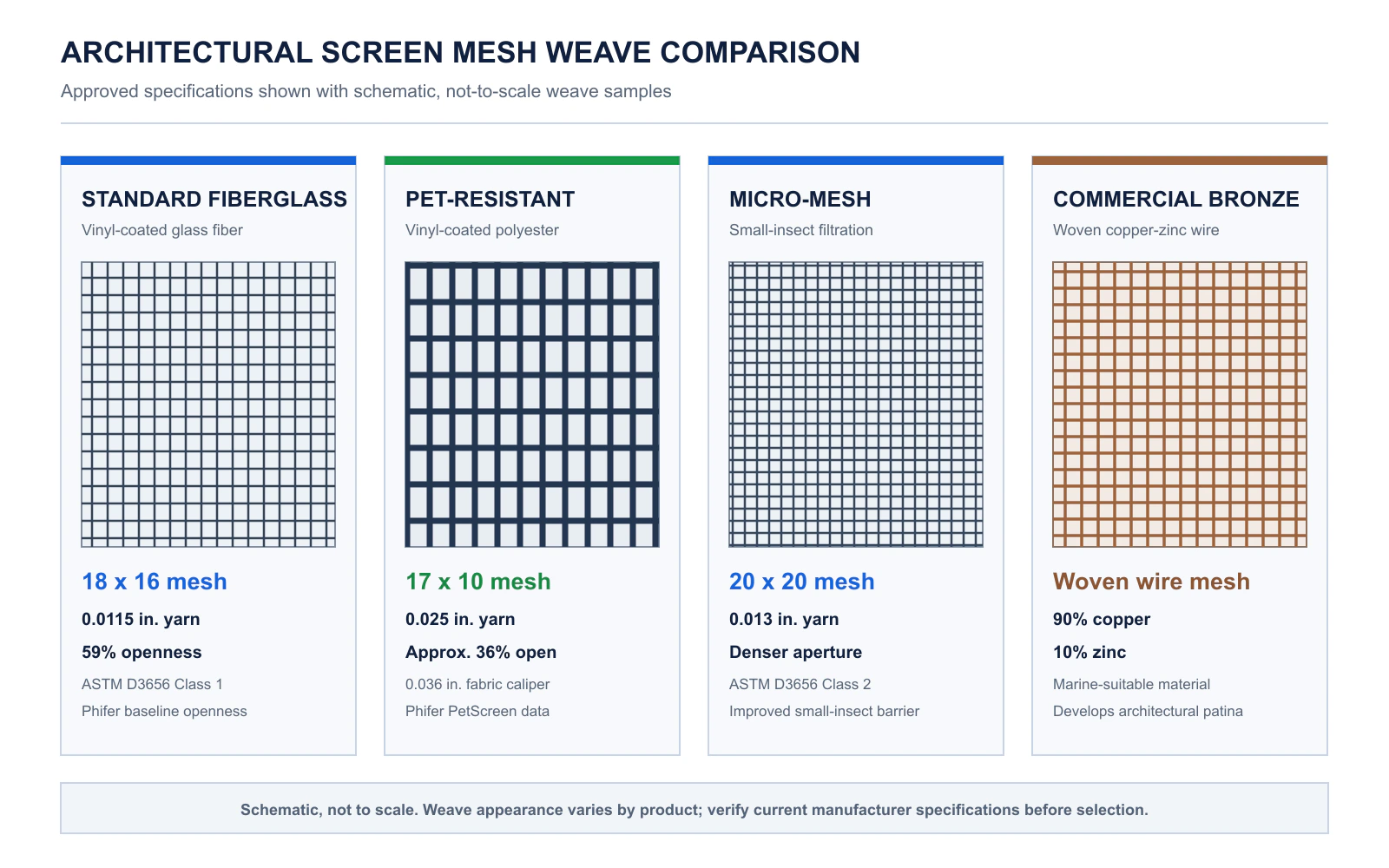
- Mesh Count (Warp x Fill): Expressed as two numbers (e.g., 18x16). The first number represents the number of vertical warp yarns per linear inch; the second represents the horizontal fill (weft) yarns per linear inch.
- Yarn & Wire Caliper: The outside diameter of the individual strands. Standard vinyl-coated glass yarns use a nominal 0.0115 in. diameter, standard aluminum insect wire measures nominal 0.011 in., while heavy-duty pet screening incorporates thick 0.025 in. polyester core yarns.
- Openness Factor (% Open Area): The percentage of the screen fabric that consists of open space rather than yarn material. The openness factor influences natural airflow, optical visibility, and visible light transmission; higher openness allows more light and less resistance to airflow, while lower openness provides greater shading and insect filtration.
Vinyl-Coated Fiberglass Screening (The Residential Standard)
Vinyl-coated fiberglass is the most widely installed insect screening material in modern residential construction due to its flexibility, non-rusting characteristics, and economical cost.
| Class 1 - Standard Residential Grade | Class 2 - Enhanced / Specialty Grade |
|---|---|
| Weave Count: 18x16 mesh | Weave Counts: 18x14 or 20x20 mesh |
| Nominal Yarn: 0.0115 in. (0.292 mm) | Nominal Yarn: 0.013 in. (0.330 mm) |
| Standard residential insect seal | Enhanced yarn stability or small-insect filtration |
| 59% Openness (Phifer baseline) |
ASTM Consensus Standards (ASTM D3656/D3656M-25)
Residential fiberglass screening is manufactured and tested under ASTM D3656/D3656M-25 (Standard Specification for Insect Screening and Louver Cloth Woven from Vinyl-Coated Glass Yarns), which formally defines two product classes:Consensus Industry Standard
- Class 1 (Standard 18x16 Weave): Specified with a nominal yarn diameter of 0.0115 in. (0.292 mm). Class 1 18x16 represents the baseline for residential window and patio door assemblies, providing reliable exclusion of houseflies, mosquitoes, and standard insects.Consensus Industry Standard
- Class 2 (18x14 and 20x20 Weaves): Specified with a heavier nominal yarn diameter of 0.013 in. (0.330 mm). The 18x14 construction is commonly used where larger spans benefit from slightly thicker yarn stability, while the dense 20x20 weave provides specialized small-insect filtration.Consensus Industry Standard
Optical Clarity & Light Transmission
According to manufacturer published specifications (Phifer Incorporated), standard charcoal 18x16 fiberglass insect screening provides an openness factor of 59% and a visible light transmission of 69%. Darker charcoal or black coatings absorb glare, offering clearer outward visibility than bright finishes.Manufacturer Specification
Heavy-Duty Vinyl-Coated Polyester (Pet & High-Traffic Mesh)
Standard fiberglass screening can tear when subjected to clawing by domestic dogs and cats or impact from active children. Heavy-duty pet-resistant screening replaces glass filaments with heavy-denier polyester yarns coated in protective vinyl.
| Standard Fiberglass (18x16) | Phifer PetScreen (17x10) |
|---|---|
| Yarn Diameter: 0.0115 in. | Yarn Diameter: 0.025 in. |
| ASTM D3656 Class 1 specification | Fabric Caliper: 0.036 in. |
| Openness Factor: 59% (Phifer) | Openness Factor: ~36% (Phifer) |
| Standard Spline: .140" in common residential frame grooves | Reduced Spline: .125" (one size smaller in common frame examples) |
Technical Material Specifications (Phifer PetScreen)
Technical data sheets for Phifer PetScreen establish the following physical benchmarks:Manufacturer Specification
- Weave Geometry: 17x10 mesh count (17 warp yarns x 10 fill yarns per inch).Manufacturer Specification
- Yarn Caliper: Heavy 0.025 in. (warp and fill) vinyl-coated polyester core yarn.Manufacturer Specification
- Finished Fabric Caliper: 0.036 in. (0.914 mm) total finished thickness.Manufacturer Specification
- Openness Factor: Approximately 36% open area.Manufacturer Specification
Mechanical Behavior & Spline Displacement
Because PetScreen incorporates heavy-gauge 0.025" polyester yarns and a 0.036" finished fabric caliper, it displaces significantly more volume inside the aluminum frame's spline groove than standard fiberglass. As established in manufacturer guidelines, installers must step down to one spline size smaller (specifying .125 in. spline for PetScreen in common frame examples where standard fiberglass uses .140 in.) to avoid warping lightweight aluminum rails or splitting frame corner keys.Manufacturer Specification
Micro-Mesh & Insect Filtration (No-See-Um 20x20 Weaves)
In coastal marshes, river valleys, and sandy regions, tiny biting insects—such as biting midges, gnats, and punkies (family Ceratopogonidae, commonly known as "no-see-ums")—can pass through the openings of standard 18x16 mesh.
- Weave Geometry (ASTM D3656 Class 2): 20x20 mesh count (20 vertical warp yarns x 20 horizontal fill yarns per square inch) using nominal 0.013 in. yarn.Consensus Industry Standard
- Filtration Mechanics: The 20x20 weave creates substantially smaller open apertures than standard 18x16 screening and is commonly selected to provide improved protection against very small insects. Exact exclusion performance depends on product weave geometry and specific insect dimensions.Variable by System / Environment
- Trade-Off Considerations: The tighter aperture reduces open area compared to standard 59% openness fiberglass. For homes in marsh regions, the added insect filtration is typically prioritized over maximum open area.Common Trade Practice
Solar Screen Mesh & Heat Attenuation
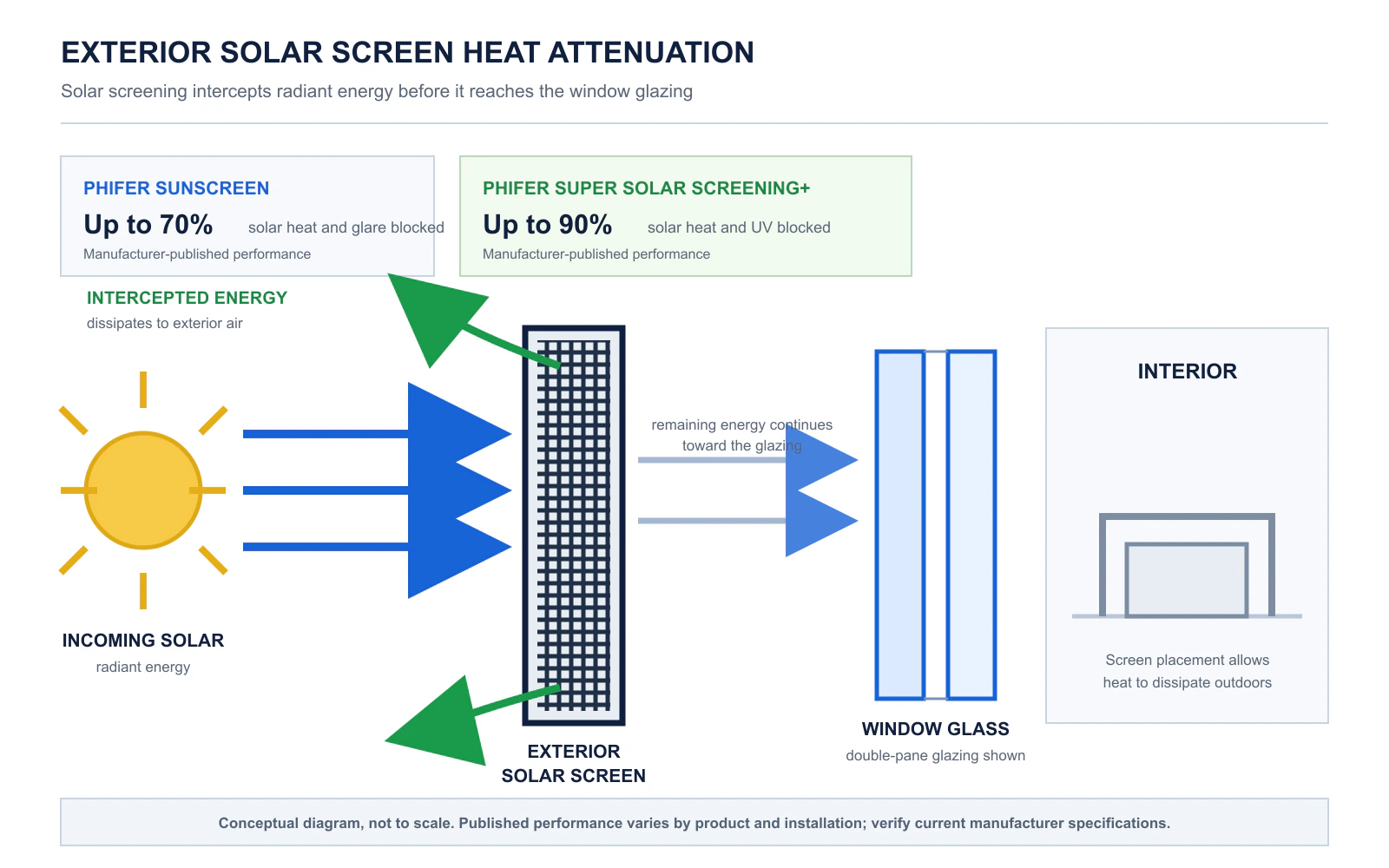
Solar screening is engineered to absorb and dissipate solar heat energy before it strikes the window glazing, reducing solar heat gain coefficients (SHGC) and interior cooling loads.
Consensus & Manufacturer Performance Ratings
- ASTM Consensus Standard (ASTM D4028/D4028M-25): Governs commercial solar screening woven from vinyl-coated fiberglass yarns with ribbed warp patterns, specifying criteria for fabric stability, breaking strength, and solar heat reduction.Consensus Industry Standard
Published Shading Performance (Phifer Branded Specifications)
- Phifer SunScreen: Engineered to block up to 70% of solar heat and glare before reaching the glass.Manufacturer Specification
- Phifer Super Solar Screening+: Dense precision weave engineered to block up to 90% of solar heat and UV radiation.Manufacturer Specification
- Installation Placement: Exterior solar screening intercepts incoming radiant energy before it reaches the exterior glass surface, allowing heat to dissipate into outdoor air rather than passing through the glazing.Common Trade Practice
Metal Wire Screening: Aluminum and Commercial Bronze
Metal wire screening provides structural rigidity, crisp historical aesthetics, and distinct environmental advantages over polymer-coated yarns.
| Aluminum Wire (18x16) | Commercial Bronze (90/10) |
|---|---|
| Wire Caliper: Nominal 0.011 in. | Composition: 90% Copper / 10% Zinc |
| Finishes: Charcoal, Black, Brite | Finishes: Bright (weathers to dark) |
| Rigid: Won't sag or stretch | Marine Suitability: High resistance to salt-air corrosion compared to aluminum; forms natural patina |
| Caution: Prone to creasing/denting if impacted during installation |
1. Aluminum Insect Screening (Phifer Specifications)
Standard residential aluminum insect screening is woven from aluminum alloy wire:Manufacturer Specification
- Weave & Wire Gauge: Woven in an 18x16 mesh count using a nominal 0.011 in. wire diameter.Manufacturer Specification
- Characteristics: More rigid than fiberglass, holding its form without stretching. However, aluminum screening requires careful handling during fabrication because it is susceptible to permanent creasing or denting if impacted.Manufacturer Specification
2. Commercial Bronze Screening (Phifer Specifications)
Commercial bronze screen wire is composed of 90% copper and 10% zinc:Manufacturer Specification
- Corrosion Performance in Coastal Environments: As documented by manufacturer technical guidance (Phifer), commercial bronze screening provides superior resistance to salty, high-humidity coastal air compared to standard aluminum wire, which can pit and corrode in marine atmospheres. Bronze screening does not corrode in this manner and is recommended for oceanfront installations.Manufacturer Specification
- Aesthetic Weathering: Manufactured with a bright, natural golden-copper luster that gradually oxidizes over time into a protective, dark bronze architectural patina. Commonly specified for historical restorations, copper-accented architecture, and oceanfront properties.Manufacturer Specification
Environmental & Climate Selection Considerations
Choosing screen mesh requires evaluating the primary environmental stress factors of your geographic region:
| Primary Challenge | Recommended Mesh | Key Advantage |
|---|---|---|
| Coastal Salt Spray / High Humidity | 90/10 Commercial Bronze; Vinyl-Coated Polyester | Superior marine corrosion resistance; avoids aluminum pitting |
| High Solar Exposure / Sun Glare | Solar Screening (SunScreen/Super Solar) | Intercepts up to 70% or 90% of solar heat |
| Household Pets / High Impact | Heavy-Duty Polyester (e.g., PetScreen) | Heavy .025 in. yarn resists claw tears |
| Marshland / Tiny Gnats / No-See-Ums | 20x20 Micro-Mesh (ASTM D3656 Class 2) | Tight aperture blocks smaller insects |
Master Mesh Specification Reference
The table below compiles physical properties and source-verified specifications across standard window and door screen materials:
| Mesh Material Category | Applicable Standard / Specification | Typical Weave Count | Nominal Yarn / Wire Diameter | Finished Fabric Caliper | Openness Factor | Primary Field Usage |
|---|---|---|---|---|---|---|
| Standard Fiberglass | ASTM D3656/D3656M-25 (Class 1) | 18x16 | 0.0115 in. | Variable | 59% (Phifer) | Standard residential windows and sliding patio doors |
| Heavy Fiberglass | ASTM D3656/D3656M-25 (Class 2) | 18x14 | 0.013 in. | Variable | Variable | Large porch openings and wide patio screens |
| Micro-Mesh (No-See-Um) | ASTM D3656/D3656M-25 (Class 2) | 20x20 | 0.013 in. | Variable | Variable | Coastal and marsh regions with biting gnats |
| Pet-Resistant Polyester | Phifer PetScreen Manufacturer Spec | 17x10 | 0.025 in. | 0.036 in. (Phifer) | ~36% (Phifer) | Lower patio screens, screen doors, and pet areas |
| Solar Screening (SunScreen) | ASTM D4028 & Phifer Spec | Ribbed Weave | Variable | Variable | Variable | Up to 70% solar heat/glare blockage |
| Solar Screening (Super Solar) | ASTM D4028 & Phifer Spec | Dense Weave | Variable | Variable | Variable | Up to 90% solar heat/UV blockage |
| Aluminum Wire | Phifer Manufacturer Spec | 18x16 | 0.011 in. | Variable | Variable | Traditional residential aluminum frame screens |
| Commercial Bronze | Phifer Manufacturer Spec (90/10) | 18x14 | Nominal Wire | Variable | Variable | Coastal marine environments and historic restorations |
Caliper dimensions, openness factors, and blockage figures are cited directly from consensus standards (ASTM) or manufacturer technical data sheets (Phifer). Verify frame compatibility before ordering.
Frequently Asked Questions (AEO Direct Answers)
What is the standard mesh size for residential window screens?
The standard residential window screen mesh is 18x16 fiberglass, governed by ASTM D3656 Class 1. This weave features 18 vertical warp yarns and 16 horizontal fill yarns per square inch with a nominal 0.0115 inch yarn diameter, providing an openness factor of approximately 59% in representative manufacturer specifications (such as Phifer).
How does pet screen compare to standard fiberglass mesh in openness and airflow?
Heavy-duty pet screening (such as Phifer PetScreen) has a published openness factor of approximately 36%, compared to 59% for standard 18x16 fiberglass screening. The lower openness factor is due to its thicker 0.025 inch vinyl-coated polyester yarns, which provide tear resistance against claws. While higher openness generally allows less resistance to airflow, exact airflow performance varies by installation and pressure conditions.
How much heat do solar screen fabrics block?
Heat reduction depends on the specific product specification. Manufacturer ratings for products tested under solar screening standards (such as ASTM D4028) show that Phifer SunScreen blocks up to 70% of solar heat and glare, while Phifer Super Solar Screening+ blocks up to 90% of solar heat and UV radiation before it strikes the window glass.
What is the best window screen mesh for homes near the ocean?
For coastal environments exposed to salt-laden air, 90/10 commercial bronze screening (90% copper, 10% zinc) and vinyl-coated polyester mesh are widely recommended. Technical documentation from manufacturers such as Phifer notes that commercial bronze provides superior resistance to marine salt air compared to aluminum wire screening, which is prone to oxidation and pitting in coastal climates. Over time, bronze screening oxidizes into a dark protective architectural patina.
Technical References & Standards Reviewed
The technical specifications in this manual are verified against the following consensus standards and primary manufacturer data sheets:
- ASTM InternationalASTM D3656/D3656M-25: Standard Specification for Insect Screening and Louver Cloth Woven from Vinyl-Coated Glass Yarns
- ASTM InternationalASTM D4028/D4028M-25: Standard Specification for Solar Screening Woven from Vinyl-Coated Fiber Glass Yarn
- Phifer IncorporatedStandard Fiberglass Insect Screen Product Specification
- Phifer IncorporatedPetScreen Technical Product Data Sheet
- Phifer IncorporatedSunScreen Technical Product Specification
- Phifer IncorporatedSuper Solar Screening+ Product Specification
- Phifer IncorporatedAluminum Insect Screen Product Data
- Phifer IncorporatedBronze Screen Product Specification & Coastal Guide
- Phifer IncorporatedHow to Choose the Right Spline Size Guide & Selection Chart
For Screen Professionals
ScreenOps helps screen companies manage customers, measurements, estimates, fabrication, field work, and operations.
Explore ScreenOps