
Direct Summary (Quick Answer)
There is no single "best" window screen mesh for every home; the appropriate material depends on how the screen will be used and the physical stresses it will encounter. Standard vinyl-coated fiberglass (governed by ASTM D3656 Class 1) is a flexible, cost-effective general-purpose mesh providing 59% open area and 69% visible light transmission in representative charcoal products. Aluminum wire screening provides a rigid drawn-metal alternative, but it is subject to permanent creasing or denting if impacted and requires consideration in coastal salt-air environments where bare metal can pit. Heavy-duty vinyl-coated polyester (such as Phifer PetScreen) is engineered specifically for applications where dogs or cats frequently contact the screen, utilizing heavy 0.025-inch core yarns and a 0.036-inch finished fabric caliper for pet-related tear and puncture resistance at the expense of lower geometric open area (approximately 36%).
How Fiberglass, Aluminum, and Pet Screen Differ
How to Evaluate Screen Mesh Claims
To maintain factual clarity, information across this comparison is distinguished across five specific levels of authority:
- Consensus Industry Standards: Industry-wide consensus specifications published by recognized standards bodies, including ASTM International standard specifications.Consensus Industry Standard
- Manufacturer Specifications: Published dimensional data, yarn gauges, openness factors, light transmission ratings, and spline selection guidance for specific branded products.Manufacturer Specification
- Manufacturer Performance Claims: Stated product capabilities marketed by a specific manufacturer, such as Phifer tear- and puncture-resistance claims for PetScreen.Manufacturer Performance Claim
- Common Trade Practices: Widely documented field handling techniques and fabrication practices used when installing different mesh materials.Common Trade Practice
- Variable by Product or Application: Conditions where the answer legitimately depends on the specific mesh product, frame groove, local exposure, installer handling, or window system.Variable by Product / Application
Window screen fabrics are engineered around three distinct material cores: flexible glass filaments, drawn aluminum wire, and heavy polyester yarn. ASTM D3656 Class 1 provides the consensus baseline for standard vinyl-coated glass yarn insect screening, while product-specific Phifer documentation supplies the cited openness, light transmission, aluminum, PetScreen, and spline data in this comparison.
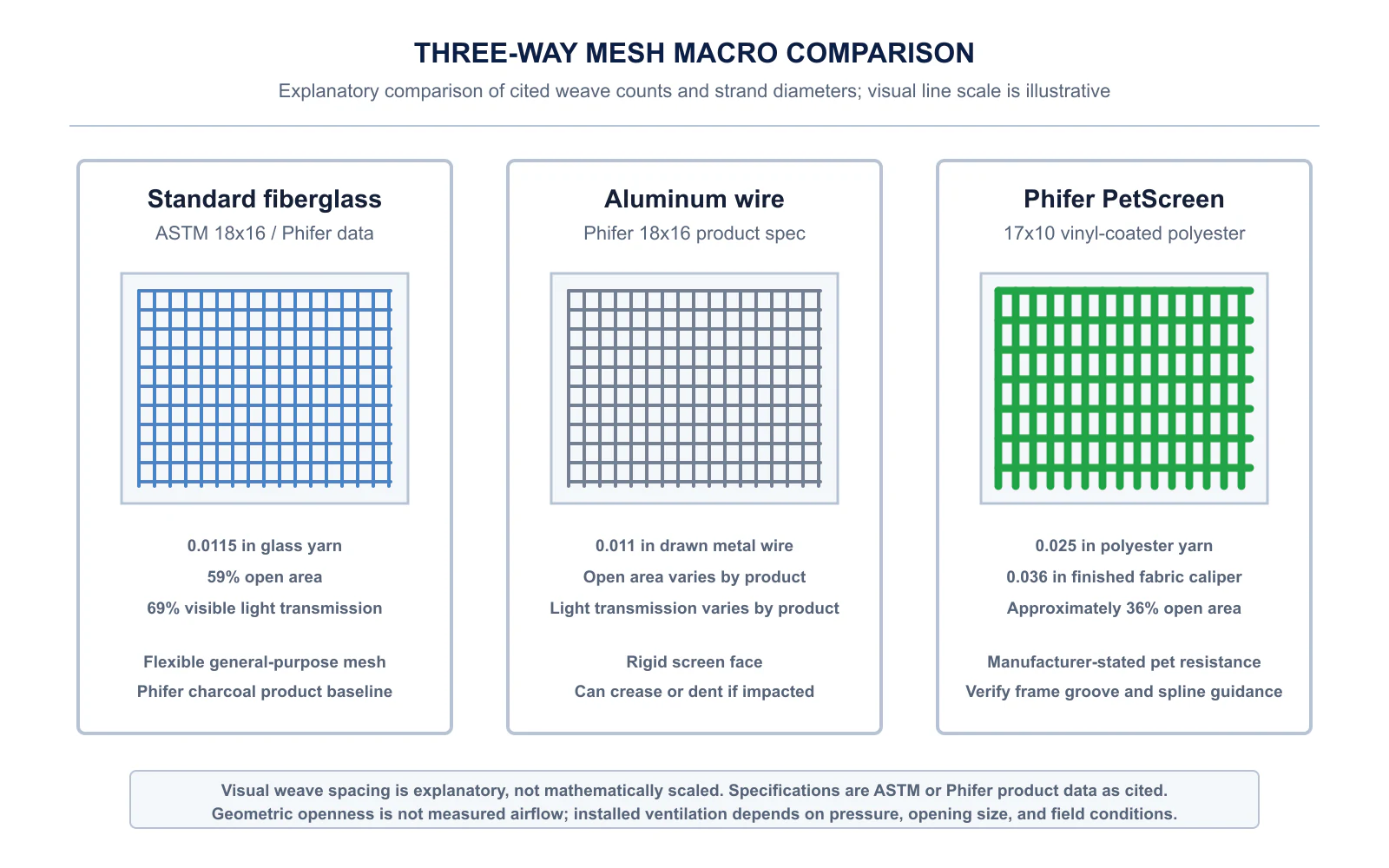
The difference between these three materials is primarily a balance between yarn diameter, fabric flexibility, geometric openness, and mechanical deformation behavior.
Quick Comparison Reference Table
The table below compiles verified dimensional specifications, manufacturer product data, and documented handling considerations across the three primary residential options:
| Material Category | Representative Product Specification | Evidence Scope | Nominal Yarn / Wire Diameter | Geometric Openness | Visible Light Transmission | Impact & Handling Characteristics | Spline Sizing Context (Representative Frames) |
|---|---|---|---|---|---|---|---|
| Standard Vinyl-Coated Fiberglass | ASTM D3656 Class 1 (18x16) / Phifer Spec | Consensus Industry Standard / Manufacturer Specification | 0.0115 in. (0.292 mm) | 59% (Phifer baseline) | 69% (Phifer charcoal) | Flexible yarn; recovers from incidental bumps without denting | Baseline manufacturer example: .140 inch in 5/16 inch roll-formed rails |
| Drawn Aluminum Wire Screening | Phifer Aluminum Product Spec (18x16) | Manufacturer Specification / Common Trade Practice | 0.011 in. (0.279 mm) | Varies by product | Varies by product | Rigid wire; subject to permanent creasing or denting if impacted | Manufacturer example: .125 inch in representative Phifer 5/16 inch frame configurations |
| Heavy-Duty Vinyl-Coated Polyester | Phifer PetScreen Technical Spec (17x10) | Manufacturer Specification / Manufacturer Performance Claim | 0.025 in. (0.635 mm) | Approximately 36% (Phifer data) | Varies by product | Heavy 0.036 inch fabric; engineered to resist pet claw punctures | Manufacturer example: .125 inch in representative Phifer frame configurations |
Dimensional specifications, openness percentages, and light transmission ratings represent consensus standards or published manufacturer technical data sheets. Geometric openness is not measured airflow. Verify specific window frame channels before ordering materials.
Standard Vinyl-Coated Fiberglass (The General-Purpose Baseline)
Vinyl-coated fiberglass is a common residential insect-screening material, combining flexibility with relatively economical material cost.
Physical Construction & Optical Properties
Governed by ASTM D3656/D3656M-25 Class 1, standard fiberglass screening is woven from glass filament yarns coated with a protective vinyl polymer. In technical product data published by Phifer Incorporated, standard 18x16 charcoal fiberglass provides an open area of 59% and a visible light transmission rating of 69%. Dark charcoal and black coatings absorb sunlight glare, allowing clean optical transparency when viewing outdoor scenery.Manufacturer Specification
- Specification Standard: ASTM D3656/D3656M-25 Class 1.Consensus Industry Standard
- Mesh Count: 18x16, meaning 18 warp ends by 16 fill picks per inch.Consensus Industry Standard
- Nominal Yarn Caliper: 0.0115 in. (0.292 mm).Consensus Industry Standard
- Openness and Light: 59% open area and 69% visible light transmission in representative Phifer charcoal product data.Manufacturer Specification
- Cost Category: Identified by Phifer as a cost-effective general-purpose screening material.Manufacturer Specification
Mechanical Behavior & Dent Resistance
Because vinyl-coated glass yarns are flexible, fiberglass screening exhibits elastic recovery when subjected to light incidental contact. In product documentation, Phifer notes that fiberglass mesh will not dent or crease when bumped, making it forgiving during installation and general household use.Manufacturer Performance Claim
Practical Limitations
Standard fiberglass is not marketed or specified as a pet-resistant specialty screen, and its nominal 0.0115-inch yarns are not designed to withstand concentrated scratching or climbing from domestic animals.
Aluminum Wire Screening (The Traditional Metal Option)
Aluminum insect screening is woven from drawn aluminum alloy wire, providing a traditional metal screen option with rigid structural characteristics.
Physical Construction & Rigidity
Standard residential aluminum insect screening, such as Phifer's aluminum product line, is woven in an 18x16 mesh count using 0.011-inch diameter drawn aluminum alloy wire. Woven metal wire creates a firm, rigid mesh surface.Manufacturer Specification
- Product Specification: Phifer Aluminum Insect Screening.Manufacturer Specification
- Mesh Count: 18x16 mesh.Manufacturer Specification
- Nominal Wire Caliper: 0.011 in. (0.279 mm).Manufacturer Specification
- Available Finishes: Charcoal, black, and brite.Manufacturer Specification
Fabrication & Handling Considerations
While aluminum wire's rigidity provides a firm screen face, it exhibits plastic deformation when subjected to localized force. Trade tooling manuals, including C.R. Laurence installation guides, note that aluminum wire is susceptible to permanent creasing or denting if mishandled or rolled improperly. Professional installation frequently involves using a convex roller wheel to pre-crease the wire into the channel before seating the spline.Common Trade Practice
Environmental Considerations
In published technical guidance, including Phifer screening FAQs and coastal selection guides, bare aluminum screening is identified as susceptible to oxidation and surface pitting when exposed to salty, high-humidity marine air.Manufacturer Specification
Heavy-Duty Pet-Resistant Polyester (Phifer PetScreen Specifications)
Pet-resistant screening is an engineered specialty mesh designed to resist damage in applications where domestic pets contact the screen.
Physical Benchmarks (Phifer PetScreen Technical Data)
Technical data sheets for Phifer PetScreen document a 17x10 mesh count, 0.025-inch vinyl-coated polyester yarns in the warp and fill directions, 0.036-inch (0.914 mm) overall finished fabric thickness, and approximately 36% geometric open area.Manufacturer Specification
- Core Material: Vinyl-coated polyester yarn.Manufacturer Specification
- Weave Count: 17x10 mesh count.Manufacturer Specification
- Yarn Caliper: 0.025 in. (0.635 mm) warp and fill.Manufacturer Specification
- Finished Fabric Caliper: 0.036 in. (0.914 mm).Manufacturer Specification
- Openness Factor: Approximately 36% geometric open area.Manufacturer Specification
Manufacturer-Stated Pet Resistance
Phifer markets PetScreen specifically as an ultra-durable specialty screen engineered to resist tears and punctures caused by dogs and cats scratching, climbing, or pushing on the screen. The combination of heavy polyester core yarns and protective vinyl coating provides resistance against claw abrasion compared to standard insect screening.Manufacturer Performance Claim
Tradeoffs: Open Area & Spline Sizing
Because PetScreen utilizes 0.025-inch yarns, its geometric openness is approximately 36%, compared to 59% for standard fiberglass. Geometric openness is not measured airflow; exact ventilation performance depends on ambient wind pressure, window opening dimensions, and local conditions.
Because PetScreen's 0.036-inch finished thickness occupies more space inside frame channels, Phifer's selection guidance specifies a smaller spline in the representative frame configurations discussed here. For broader manufacturer-attributed spline context, see the step down to a smaller spline diameter guidance in the ScreenOps spline chart.Manufacturer Specification
Direct Head-to-Head Comparisons
| Face-Off | Key Difference | Practical Outcome | Evidence Scope |
|---|---|---|---|
| Fiberglass vs. Aluminum | Flexible glass yarn vs. rigid drawn metal wire | Fiberglass recovers from light bumps; aluminum can permanently dent or crease. | Manufacturer Specification / Common Trade Practice |
| Fiberglass vs. PetScreen | 0.0115 inch yarn and 59% openness vs. 0.025 inch yarn and approximately 36% openness | Fiberglass favors general-purpose light and openness; PetScreen is manufacturer-positioned for pet contact. | Consensus Industry Standard / Manufacturer Performance Claim |
| Aluminum vs. PetScreen | Rigid metal wire vs. heavy coated polyester | Aluminum provides a firm wire face; PetScreen is engineered for dog and cat tear and puncture resistance. | Manufacturer Specification / Manufacturer Performance Claim |
Fiberglass vs. Aluminum
- Flexibility & Dent Behavior: Standard fiberglass is flexible, recovering from light physical bumps without denting. Aluminum wire is rigid, but it can permanently dent, crease, or bow if impacted by localized force or installation tools.Common Trade Practice
- Relative Cost: In manufacturer product guides, Phifer identifies fiberglass as a more cost-effective material than aluminum wire. Actual material and installed costs vary by roll size, supplier, and installer.Manufacturer Specification
- Environmental Exposure: Fiberglass and polyester are non-metallic screening alternatives and therefore do not undergo aluminum-style metal oxidation, whereas bare aluminum wire can pit and oxidize in coastal salt-air environments.Manufacturer Specification
Fiberglass vs. Pet Screen
- Yarn Gauge & Thickness: PetScreen uses 0.025-inch diameter polyester core yarns, more than double the 0.0115-inch nominal diameter of ASTM Class 1 fiberglass, yielding a finished fabric thickness of 0.036 inches.Manufacturer Specification
- Open Area & Light: Standard fiberglass provides 59% openness and 69% visible light transmission in representative Phifer charcoal product data, offering higher visible light passage and less geometric resistance than PetScreen's approximately 36% openness.Manufacturer Specification
- Claw Resistance: Phifer markets PetScreen specifically for dog and cat tear resistance; standard fiberglass is not marketed or specified as a pet-resistant product.Manufacturer Performance Claim
- Frame Spline Fit: Phifer's selection guidance specifies a smaller spline in the representative frame configurations discussed here.Manufacturer Specification
Aluminum vs. Pet Screen
- Material Properties: Aluminum consists of 0.011-inch drawn metal wire woven at 18x16; PetScreen consists of 0.025-inch vinyl-coated polyester woven at 17x10.Manufacturer Specification
- Impact & Damage Mode: When subjected to heavy scratching or localized force, aluminum wire can crease or dent permanently. PetScreen's heavy polyester yarns are engineered specifically for pet-related tear and puncture resistance.Manufacturer Performance Claim
- Channel Fit: In manufacturer selection tables for representative 5/16 inch and 7/16 inch frames, Phifer lists both aluminum wire and PetScreen with .125 inch spline, though their physical fit contexts differ. Aluminum wire does not compress like flexible fiberglass, while PetScreen's thick fabric displaces more channel volume.Manufacturer Specification
Which Screen Mesh Should You Choose? (Conditional Decision Guide)
Select screening material based on specific household needs, opening locations, environmental conditions, and measuring and sizing protocols before ordering replacement mesh.
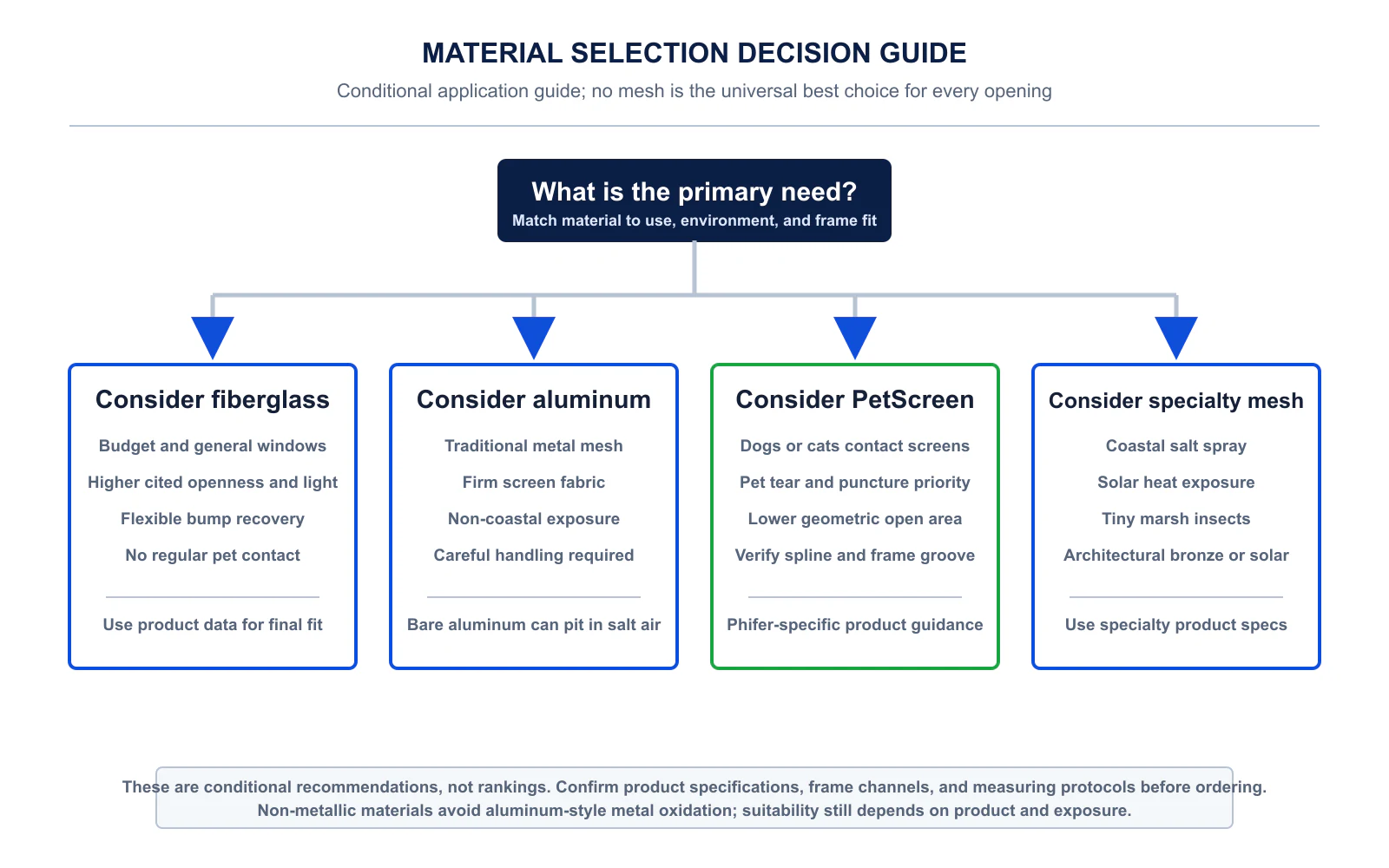
- Consider standard fiberglass when: Budget economy and general-purpose screening are primary priorities; maximizing visible light transmission and open area matters; the application does not involve regular contact from dogs or cats; and you prefer a flexible mesh that recovers from incidental bumps.
- Consider aluminum wire screening when: You prefer a traditional, rigid metal mesh; the application requires a firm screen fabric; and the installation is in a non-coastal environment where salt pitting is not an active concern.
- Consider heavy-duty pet-resistant polyester when: Household dogs or cats regularly scratch, paw, or push on the screen; resistance to pet-related tears and punctures is prioritized over maximum geometric open area; and frame channels can accommodate manufacturer-recommended spline sizing.
- Consider specialty architectural meshes when: Coastal salt spray requires marine alloys like commercial bronze, intense radiant heat exposure requires solar screening, or tiny marsh gnats require dense 20x20 micro-mesh.
Coastal & Environmental Considerations
In coastal regions subject to ocean salt spray and elevated humidity, material selection requires careful evaluation.
- Aluminum Wire Considerations: Technical guidance from screen manufacturers notes that bare aluminum insect wire is susceptible to corrosion, oxidation, and surface pitting when exposed to marine salt air.Manufacturer Specification
- Non-Metallic Alternatives: Vinyl-coated fiberglass and vinyl-coated polyester utilize polymer jackets and do not undergo aluminum-style metal oxidation. Suitability for a specific coastal opening depends on product construction, frame design, and exposure conditions.Variable by Product / Application
- Specialty Architectural Options: For oceanfront properties desiring metal wire, 90/10 commercial bronze screening is documented by manufacturers for coastal resistance and natural dark bronze patina formation. See The Architectural Screen Mesh Manual for technical specifications on bronze, solar, and micro-mesh fabrics.Manufacturer Specification
Installation & Spline Sizing Considerations
Selecting a screen mesh directly influences the tools and spline sizing required during fabrication and rescreening.
- Spline Size Adjustment (Manufacturer Sizing Guidance): Because finished fabric thickness varies significantly between materials, spline diameter must match the specific combination of frame groove and mesh thickness. In representative residential frame examples, manufacturer guides from Phifer specify .140-inch spline for fiberglass and identify .125-inch spline examples for PetScreen to accommodate the heavier fabric. For complete frame and channel compatibility data, consult The Definitive Screen Spline Sizing Chart & Compatibility Guide.Manufacturer Specification
- Window Screen Frame Channels: Window screen frame channels, frame depth, and receiving-track geometry should be verified before a material or spline diameter is selected.Variable by Product / Application
- Tooling Requirements: Rolling flexible fiberglass utilizes a standard concave roller wheel. When installing aluminum wire screening, trade manuals recommend using a convex roller wheel to pre-crease the wire into the channel before seating the spline.Common Trade Practice
Frequently Asked Questions (AEO Direct Answers)
Is fiberglass or aluminum window screen better?
Neither material is universally better; the choice depends on your installation priorities. Standard vinyl-coated fiberglass is more economical, flexible, and recovers from light bumps without denting, while providing 59% open area and 69% visible light transmission in representative charcoal products. Aluminum wire provides a rigid drawn-metal screen, but it is subject to permanent creasing or denting if impacted and is susceptible to oxidation in coastal salt-air environments.
Is pet screen better than standard fiberglass?
Pet screen, such as Phifer PetScreen, is specifically engineered for households with dogs or cats that scratch or push against screens. It uses heavy 0.025-inch vinyl-coated polyester core yarns and a 0.036-inch finished fabric caliper for pet-related tear and puncture resistance. However, standard fiberglass provides higher geometric open area (59% vs. approximately 36%) and higher visible light transmission for general window applications without pet contact.
Does pet screen reduce airflow compared to regular fiberglass screen?
Geometric open area is one factor that influences airflow and visibility. Heavy-duty pet screening has a published open area of approximately 36%, compared to 59% for standard 18x16 fiberglass. While a lower open area presents more physical yarn surface area to air movement, exact airflow performance depends on ambient wind pressure, window opening dimensions, and local ventilation conditions.
Is aluminum screen stronger than fiberglass screen?
Aluminum wire provides higher rigidity than flexible fiberglass, but it is susceptible to plastic deformation, including permanent denting or creasing, when impacted. Fiberglass is more flexible and recovers elastically from light bumps. For heavy puncture and tear resistance against animal claws, heavy-duty vinyl-coated polyester such as PetScreen is engineered specifically for durability.
What screen mesh is recommended for homes with dogs or cats?
Where domestic pets scratch, climb, or push against screens, heavy-duty vinyl-coated polyester such as Phifer PetScreen is recommended based on manufacturer-stated tear and puncture resistance. Standard fiberglass and aluminum wire are not marketed or specified for pet claw resistance.
Does aluminum window screen rust?
Aluminum does not rust like ferrous iron; it does not form iron oxide. Bare aluminum wire can oxidize and develop white corrosion pitting when exposed to salt-laden marine air and high-humidity coastal environments.
Is PetScreen harder to install than standard fiberglass?
PetScreen's greater finished fabric thickness, 0.036 inches, can change spline selection. Phifer's selection guidance shows .125-inch spline for PetScreen in representative frames where standard fiberglass uses .140-inch spline. Installers should verify their actual frame groove width and manufacturer guidance before selecting spline.
What window screen material should I choose?
Consider standard fiberglass for general household windows where cost, flexibility, open area, and light transmission are important considerations. Consider aluminum wire if you prefer a traditional rigid metal screen for non-coastal metal frames. Consider heavy-duty pet-resistant polyester for doors and windows where dogs and cats frequently contact the screen.
Technical References & Standards Reviewed
The factual specifications and comparative data in this guide are verified against the following primary consensus standards and manufacturer documentation:
- ASTM InternationalASTM D3656/D3656M-25: Standard Specification for Insect Screening and Louver Cloth Woven from Vinyl-Coated Glass Yarns
- Phifer IncorporatedStandard Fiberglass Insect Screen Product Specification
- Phifer IncorporatedPetScreen Technical Product Data Sheet
- Phifer IncorporatedAluminum Insect Screen Product Data
- Phifer IncorporatedHow to Choose Screening Material Technical Guide & Blog
- Phifer IncorporatedInsect Screening FAQ & Coastal GuidePhifer IncorporatedBronze Screen Product Specification & Coastal Guide
- Phifer IncorporatedHow to Choose the Right Spline Size Selection Chart
- C.R. Laurence Co., Inc. (CRL)CRL Professional Screen Tooling & Spline Category Catalog
For Screen Professionals
ScreenOps helps screen companies manage customers, measurements, estimates, fabrication, field work, and operations.
Explore ScreenOps