
Direct Summary (Quick Answer)
Pet-resistant screening is worth considering when dogs or cats regularly contact and damage standard screening, and pet-related tear and puncture resistance is prioritized over maximizing geometric open area. In representative manufacturer specifications, such as Phifer PetScreen, heavy 0.025-inch vinyl-coated polyester core yarns woven in a 17x10 mesh provide manufacturer-rated resistance against claw tears, but yield a lower open area, approximately 36%, than standard 18x16 vinyl-coated fiberglass, which has 59% open area and 69% visible light transmission in cited charcoal products. Standard fiberglass remains a cost-effective, general-purpose choice for openings where domestic animals do not contact the screen.
How to Distinguish Technical Claims in This Guide
To maintain factual clarity, information across this guide is categorized into distinct levels of authority:
- Consensus Industry Standards: Consensus specifications established by independent standards bodies, including ASTM International standard specifications.Consensus Industry Standard
- Manufacturer Specifications: Published dimensional measurements, yarn diameters, weave counts, and openness factors for specific branded products.Manufacturer Specification
- Manufacturer Performance Claims: Stated product capabilities marketed directly by a manufacturer, such as Phifer tear- and puncture-resistance ratings.Manufacturer Performance Claim
- Safety / Regulatory Warnings: Formal public safety advisories published by government agencies, including U.S. CPSC child fall-prevention warnings.Safety / Regulatory Warning
- ScreenOps Practical Decision Guidance: Practical editorial selection models designed to help homeowners evaluate trade-offs based on verified material characteristics.ScreenOps Practical Decision Guidance
- Variable by Product or Application: Conditions where the answer depends on the specific mesh product, frame groove, installation system, or application.Variable by Product / Application
What "Regular Screen" Means in This Comparison
"Regular screen" is consumer search terminology, not a single universal material category used across every window screen product. For this article, the comparison baseline is specifically ASTM D3656 Class 1 18x16 vinyl-coated fiberglass insect screening.Consensus Industry Standard
| Consumer term | Technical baseline used here | Standard / source | Purpose |
|---|---|---|---|
| Regular screen | Standard 18x16 vinyl-coated fiberglass insect screening | Consensus Industry Standard - ASTM D3656/D3656M-25 Class 1 | General residential insect protection |
This baseline keeps the comparison precise. It does not imply every ordinary insect screen is fiberglass.
Phifer PetScreen® vs. Generic Pet-Resistant Screening
When shopping for heavy-duty screening, distinguish between a specific trademarked product and a broad product class:
- Phifer PetScreen®: A registered trademark of Phifer Incorporated. Cited Phifer product data identifies vinyl-coated polyester yarn, a 17x10 weave, a 0.025-inch nominal yarn diameter, a 0.036-inch finished fabric caliper, and an open area of approximately 36%.Manufacturer Specification
- Generic Pet-Resistant Screening: A broad category of heavy-gauge polyester or specialty insect screens sold by various manufacturers and distributors. Weave count, yarn diameter, coating chemistry, and finished fabric thickness vary by product and manufacturer.Variable by Product / Application
Quick Comparison: Standard Fiberglass vs. Phifer PetScreen
The table below compiles verified consensus specifications, primary manufacturer data, and documented safety boundaries. For a broader three-material view including aluminum, see the three-way residential mesh comparison.
| Technical Property | Standard Vinyl-Coated Fiberglass | Heavy-Duty Polyester (Phifer PetScreen®) | Evidence Classification & Authority |
|---|---|---|---|
| Core Material | Vinyl-coated glass filament yarn | Vinyl-coated polyester core yarn | Manufacturer Specification - ASTM D3656 / Phifer product specs |
| Specification Standard | ASTM D3656 Class 1 | Branded manufacturer product specification | Consensus Industry Standard / Manufacturer Specification |
| Nominal Yarn Caliper | 0.0115 in. (0.292 mm) | 0.025 in. (0.635 mm) | Consensus Industry Standard / Manufacturer Specification |
| Standard Weave Count | 18x16 (18 warp x 16 fill ends/in.) | 17x10 (17 warp x 10 fill ends/in.) | Consensus Industry Standard / Manufacturer Specification |
| Finished Fabric Caliper | Standard thin yarn profile | 0.036 in. (0.914 mm) | Manufacturer Specification |
| Geometric Open Area | 59% (Phifer baseline data) | Approximately 36% (Phifer baseline data) | Manufacturer Specification |
| Visible Light Transmission | 69% (Phifer charcoal product) | No numerical VLT identified in cited product data | Manufacturer Specification |
| Pet Damage Rating | Not specified for animal contact | Phifer markets PetScreen as tear- and puncture-resistant against damage associated with dogs and cats | Manufacturer Performance Claim |
| Representative Spline Size | .140 in. (5/16 inch frame example) | .125 in. (5/16 inch frame example) | Manufacturer Specification - representative Phifer frame configurations |
| Safety / Containment | Not a fall-prevention barrier | Not a fall-prevention barrier | Safety / Regulatory Warning - U.S. CPSC safety advisory |
Geometric openness is not measured airflow. PetScreen spline examples are manufacturer guidance for representative frame configurations, not a universal .125-inch rule.
Material & Weave Differences
The physical difference between standard fiberglass and heavy-duty pet screening lies in core fiber chemistry, strand diameter, and weave geometry.
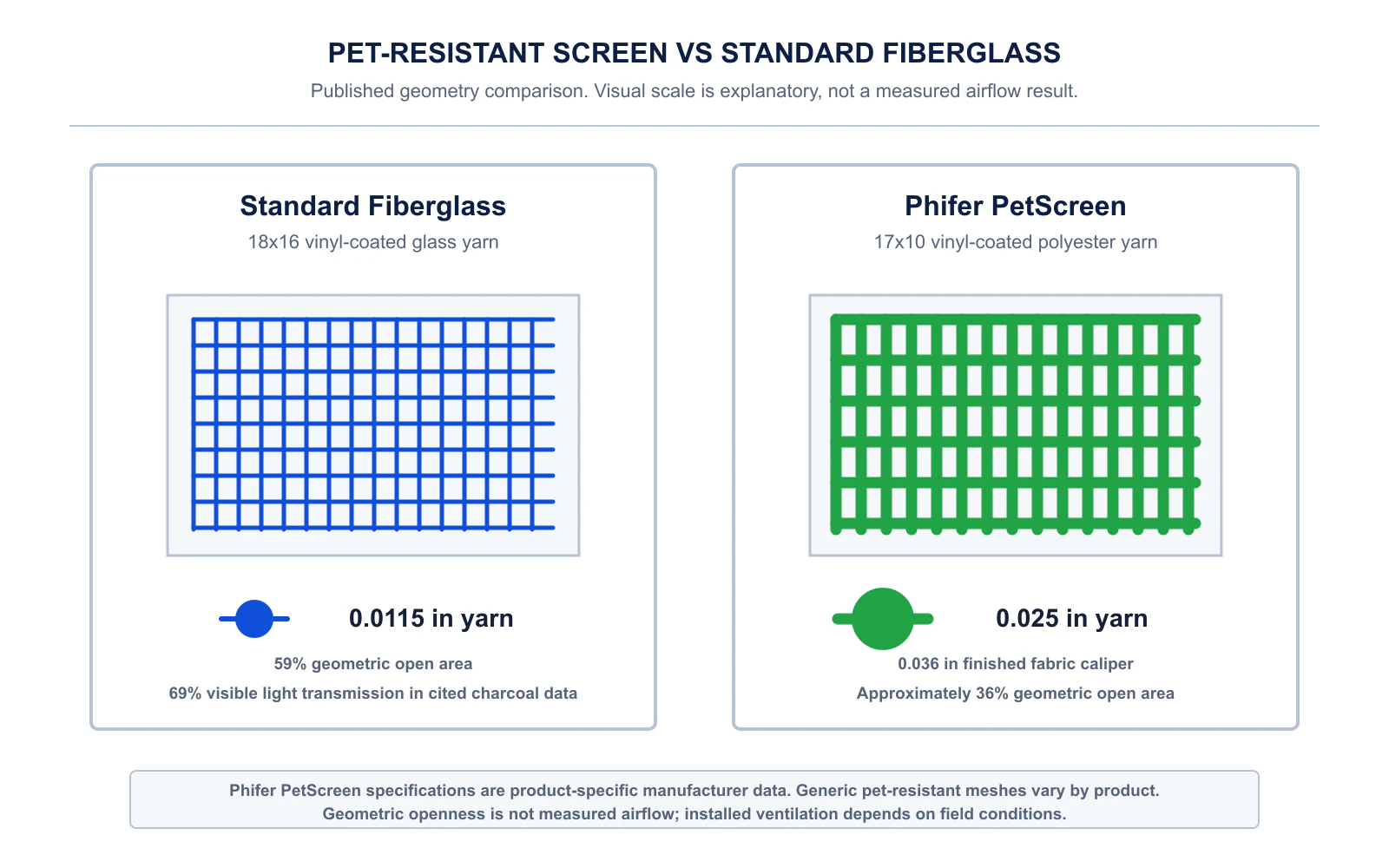
- Yarn Caliper: Standard fiberglass uses glass filaments with a nominal diameter of 0.0115 inches. Phifer PetScreen uses heavy polyester core yarns measuring 0.025 inches in diameter, more than double the nominal thickness of standard fiberglass yarns.Manufacturer Specification
- Fabric Thickness: The heavier polyester strands in Phifer PetScreen produce a finished fabric caliper of 0.036 inches (0.914 mm).Manufacturer Specification
- Weave Structure: Standard fiberglass is woven in an 18x16 mesh. Phifer PetScreen is woven in a 17x10 mesh, balancing thicker yarns with open aperture spacing.Manufacturer Specification
Pet Damage Resistance: What the Evidence Actually Supports
Search results and retail copy can blur the line between manufacturer-supported resistance claims and absolute guarantees. This guide keeps that boundary explicit.
| Evidence-supported statement | Unsupported extension this article does not make | Evidence Classification |
|---|---|---|
| Phifer markets PetScreen as tear- and puncture-resistant against damage associated with dogs and cats. | A guarantee against every type or severity of animal contact. | Manufacturer Performance Claim |
| PetScreen is a heavy-duty specialty screen for areas where animal contact is expected. | A claim that every window or door should use pet-resistant screening. | ScreenOps Practical Decision Guidance |
Phifer markets PetScreen specifically as a heavy-duty specialty screen engineered to resist tears and punctures from domestic dogs and cats scratching, climbing, or pushing on the mesh. Standard fiberglass is a general-purpose insect-screening material and does not carry the cited Phifer PetScreen tear- and puncture-resistance performance claim.Manufacturer Performance Claim
Manufacturer tear- and puncture-resistance claims describe resistance to typical claw abrasion, pawing, and climbing. They should not be interpreted as an absolute guarantee against every type or severity of animal contact.Manufacturer Performance Claim
Visibility & Geometric Open Area
Evaluating outward view characteristics requires reviewing published geometric open area and visible light transmission data:
| Material | Open Area | Visible Light Transmission | Evidence Classification |
|---|---|---|---|
| Standard fiberglass 18x16 | 59% (Phifer product data) | 69% (Phifer charcoal product data) | Manufacturer Specification |
| Phifer PetScreen 17x10 | Approximately 36% (Phifer product data) | No numerical VLT identified in cited product data | Manufacturer Specification |
This guide does not assign a PetScreen visible-light-transmission percentage because the cited PetScreen product data does not identify one.
Because PetScreen uses 0.025-inch yarns that occupy more physical space across the woven surface, the fabric provides a lower percentage of geometric open area. Phifer publishes a 69% VLT rating for charcoal fiberglass, but no numerical visible-light-transmission percentage is identified in cited PetScreen product data sheets, so this guide does not assign one.Manufacturer Specification
Airflow: Why Openness Is Not Measured Ventilation
A widespread misconception in home improvement discussions is that geometric open area equates directly to a mathematical reduction in airflow.
Geometric openness is not measured airflow. Geometric open area is one physical factor influencing passive ventilation, but it is not a direct measurement of installed air movement.Variable by Product / Application
While PetScreen has approximately 36% open area and standard fiberglass has 59% open area in the cited Phifer data, actual ventilation in a home depends on ambient wind pressure, window opening dimensions, and local room air movement.Variable by Product / Application
Installation & Spline Sizing Considerations
Because heavy-duty pet screening is thicker than standard fiberglass, installation requires verifying frame channel compatibility.
- Fabric Caliper Displacement: Phifer PetScreen's finished fabric thickness of 0.036 inches occupies more volume inside a frame's spline groove than standard fiberglass.Manufacturer Specification
- Manufacturer Sizing Guidance: In representative 5/16 inch and 7/16 inch frame examples, the Phifer Spline Selection Guide specifies .140-inch spline for standard fiberglass and directs installers to use .125-inch spline for PetScreen to accommodate the heavier fabric.Manufacturer Specification
- System Verification: This recommendation represents manufacturer guidance for representative residential frame configurations, not a universal PetScreen spline sizing rule. Installers should measure their specific frame groove width and consult manufacturer tables before selecting spline. For detailed procedures, see The Definitive Screen Spline Sizing Chart & Compatibility Guide.Manufacturer Specification
- Frame Considerations: Window screen frame channels, frame depth, and receiving-track geometry should be verified before a material or spline diameter is selected.Variable by Product / Application
Where Pet-Resistant Screen Makes Sense
In manufacturer documentation, Phifer identifies PetScreen for windows, sliding screen doors, patio and porch enclosures, and outer-door screening.Manufacturer Specification
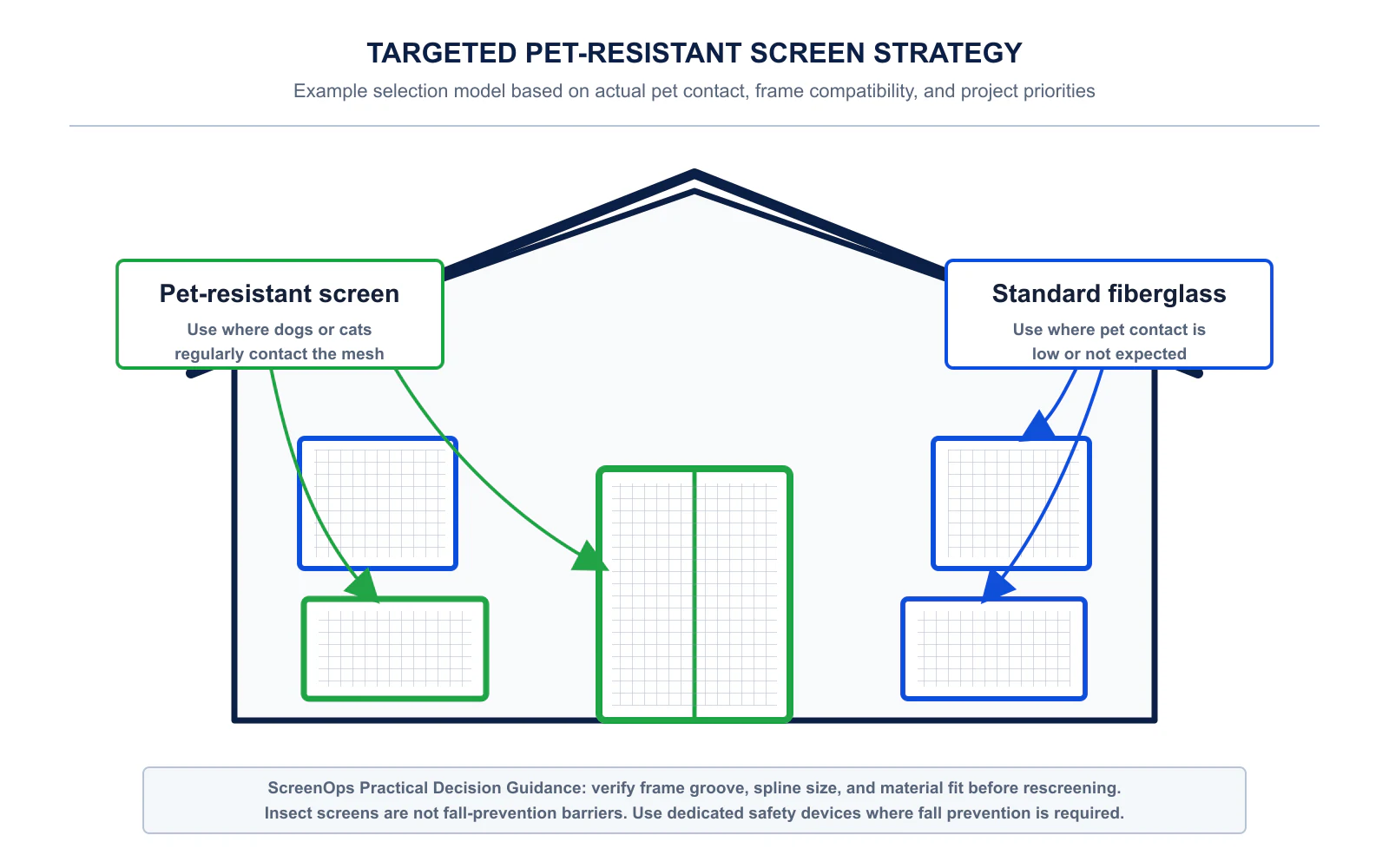
- Consider pet-resistant screening when: Household dogs or cats regularly scratch, paw, or push on the screen; rescreening openings where animal damage is an active concern; tear and puncture resistance is prioritized over maximum open area; and frame channels can accommodate manufacturer-recommended spline sizing.ScreenOps Practical Decision Guidance
- Consider standard fiberglass screening when: Openings receive little or no physical contact from domestic animals; maximizing cited visible light transmission and open area is the primary objective; and upfront material economy is a leading project priority.ScreenOps Practical Decision Guidance
- Confirm measurements before changing material: Before replacing a material, verify frame groove, opening dimensions, and installation workflow using field measuring protocols.ScreenOps Practical Decision Guidance
Is Pet Screen Worth the Additional Cost?
Evaluating whether pet-resistant screening is worth the investment depends on the specific problem being addressed.
- Relative Cost Positioning: In manufacturer technical guides, Phifer identifies standard fiberglass as its most cost-effective insect screening product, while PetScreen is positioned as a heavy-duty specialty mesh. Actual material and installation pricing varies by supplier, roll width, and market.Manufacturer Specification
- Targeted Application Guidance: Rather than rescreening an entire property with specialty pet mesh, a practical approach is to install pet-resistant screening selectively in openings where animals actively scratch or push, such as sliding patio screen doors or low window openings, while using economical standard fiberglass on openings without pet contact.ScreenOps Practical Decision Guidance
- Decision Rule: Pet-resistant screening is worth considering when pet-related screen damage is the problem being addressed. Where pet contact is not a concern, standard fiberglass remains a comparatively cost-effective general-purpose option with higher published open area in cited Phifer data.ScreenOps Practical Decision Guidance
What Pet Screen Does NOT Do: Important Safety Limitation
ASTM F2090 concerns dedicated window fall-prevention devices; it does not make ordinary insect screens fall-prevention devices.Safety / Regulatory Warning
Frequently Asked Questions (AEO Direct Answers)
Is pet screen worth it?
Pet-resistant screening is worth considering when pet-related screen damage is the problem being addressed. If an opening does not experience animal contact, standard fiberglass remains a comparatively cost-effective general-purpose option with higher published open area in cited Phifer data (59% vs. ~36%).
What is the difference between pet screen and regular screen?
"Regular" window screen is standard 18x16 vinyl-coated fiberglass (ASTM D3656 Class 1) with nominal 0.0115-inch yarn, providing 59% open area and 69% visible light transmission in representative charcoal products. Phifer PetScreen® is a specialty 17x10 mesh woven from heavy 0.025-inch vinyl-coated polyester core yarns with a 0.036-inch finished caliper, engineered specifically for pet-related tear and puncture resistance.
Can dogs or cats tear pet screen?
Phifer markets PetScreen specifically as tear- and puncture-resistant against damage from domestic dogs and cats scratching, climbing, and pushing. However, manufacturer performance claims describe resistance to claw abrasion and should not be interpreted as an absolute guarantee against every type or severity of animal contact.
Does pet screen reduce airflow?
Geometric open area is one factor influencing ventilation. Phifer PetScreen has a published open area of approximately 36%, compared to 59% for standard 18x16 fiberglass. While lower geometric open area presents more physical yarn surface to moving air, exact ventilation performance depends on ambient wind pressure, opening size, and local room air movement.
Can you see through pet screen?
Phifer publishes approximately 36% geometric open area for PetScreen, compared to 59% open area and 69% visible light transmission for standard charcoal fiberglass. Because cited PetScreen technical data does not provide a numerical visible-light-transmission percentage, this guide does not assign one.
What is pet screen made of?
Phifer PetScreen® is woven from 0.025-inch diameter vinyl-coated polyester core yarns. Standard insect screening is woven from vinyl-coated glass filament yarns.
What spline size should I use with PetScreen?
Spline selection depends on the frame's specific groove width and the mesh caliper. In representative residential 5/16" and 7/16" roll-formed frame examples, the Phifer Spline Selection Guide shows .125-inch spline for PetScreen (stepping down from .140" for fiberglass) to accommodate the heavier 0.036-inch fabric caliper. Installers should verify their actual frame groove width before selecting spline.
Is PetScreen harder to install than regular screen?
PetScreen's heavier 0.036-inch finished fabric thickness can change spline size selection compared to standard fiberglass. Installers must ensure their frame groove accommodates the thicker material and verify spline sizing against manufacturer guidance.
Can pet screen be used in regular window frames?
Pet-resistant screening can be used in compatible window-screen systems, but compatibility depends on the frame groove, mesh thickness, and spline selection. Phifer's spline guide provides representative frame examples using .125-inch spline for PetScreen where fiberglass uses .140-inch spline. Installers should verify their actual frame system before fabrication.
Is pet screen good for sliding patio screen doors?
Yes. Phifer identifies sliding screen doors as an intended application for PetScreen. Suitability still depends on the specific door frame, spline groove, and installation system.
Can pet screen keep a dog or cat from falling out of a window?
No. CPSC warns that window screens should not be relied upon to prevent children from falling from windows. Pet-resistant insect screening likewise should not be treated as a dedicated fall-prevention device. ASTM F2090 concerns dedicated window fall-prevention devices, not ordinary insect screens.
Technical References & Standards Reviewed
The factual specifications, comparative data, and safety guidance in this article are verified against the following primary consensus standards, federal advisories, and manufacturer documentation:
- ASTM InternationalASTM D3656/D3656M-25: Standard Specification for Insect Screening and Louver Cloth Woven from Vinyl-Coated Glass Yarns
- ASTM InternationalASTM F2090: Standard Specification for Window Fall Prevention Devices with Emergency Escape (Egress) Release Mechanisms
- U.S. Consumer Product Safety Commission (CPSC)National Window Safety Guidance & Fall Prevention Advisories
- Phifer IncorporatedPhifer PetScreen Technical Product Data Sheet
- Phifer IncorporatedStandard Fiberglass Insect Screen Product Specification
- Phifer IncorporatedPet Screening for Dogs and Cats & Durability Features
- Phifer IncorporatedHow to Choose the Right Spline Size Selection Chart
- Phifer IncorporatedHow to Choose Screening Material Technical Guide
For Screen Professionals
ScreenOps helps screen companies manage customers, measurements, estimates, fabrication, field work, and operations.
Explore ScreenOps